World Tourism Day 2026: When the Visitor Experience Begins Online
A traveller’s experience begins long before they arrive at the destination. On the occasion of World Tourism Day, we look at how websites, Google, SEO, online bookings, digital menus and the right content can strengthen a modern tourism business.
6 min
Reading time

Last updated
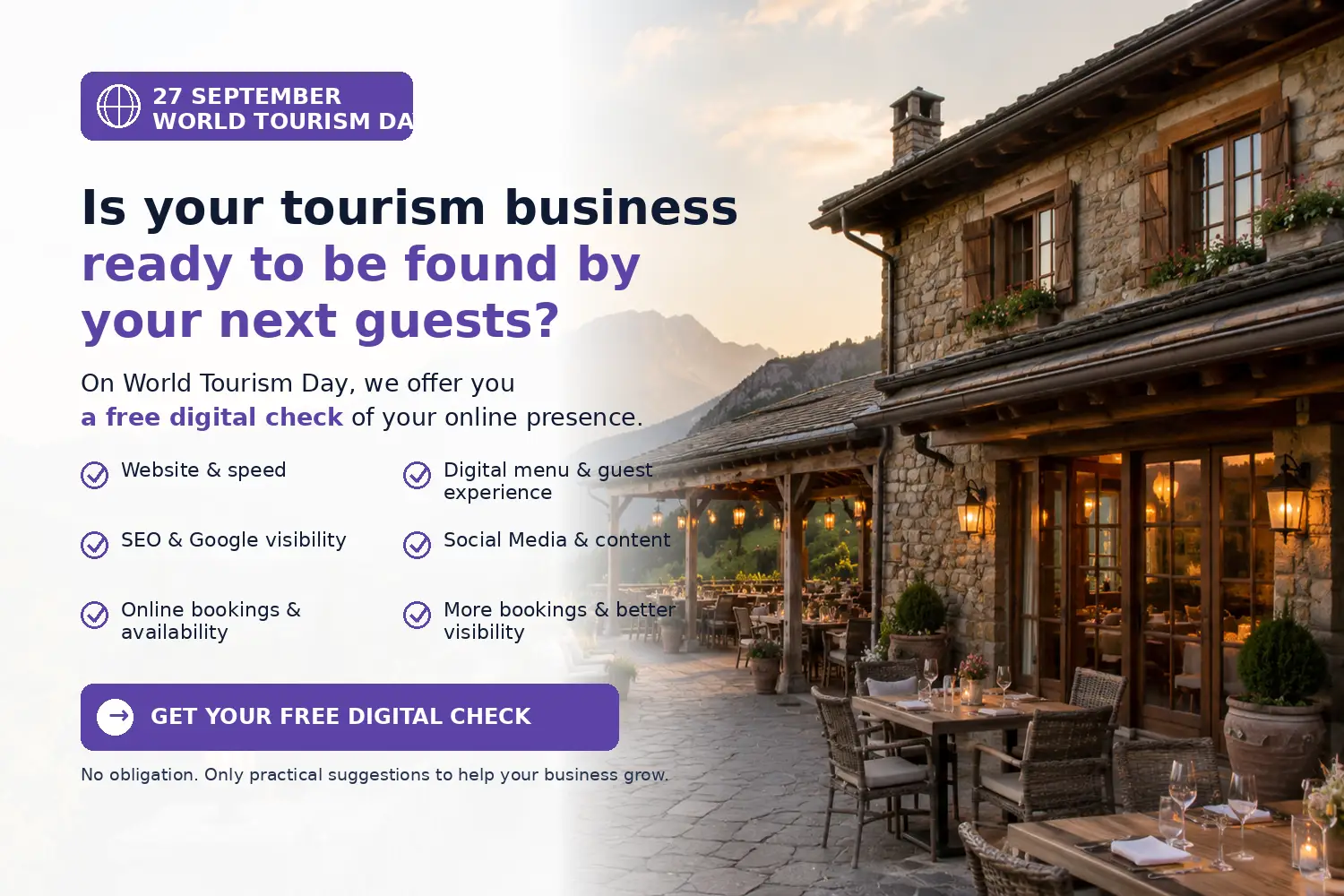
Every year on 27 September, World Tourism Day is an opportunity to remember that tourism is not only about travel and destinations.
It is about people, businesses, local communities, culture, hospitality and experiences.
For many parts of Greece — especially mountain and smaller destinations — a hotel, guesthouse, restaurant, café or small tourism business is not simply a commercial activity.
It is part of the identity of the place itself.
And today, that identity begins long before the visitor actually arrives.
It begins with a Google search. A map. A website. A photograph. A menu opened on a phone. How easily someone can understand what a business offers and take the next step.
Digital presence has now become part of the tourism experience itself.
The visitor experience begins before arrival
Imagine a traveller planning a weekend in the mountains.
They may not yet know which hotel to choose, where to eat or which café to stop at.
The process often starts with searches such as “hotel in Elati”, “where to eat in Pertouli”, “guesthouse with a view” or “restaurant near me”.
Within a few minutes, the visitor will compare businesses, photos, reviews, locations, websites, prices and information.
And in many cases, the first impression of the business has already been formed before the door is even opened.
That is why digital presence is no longer something separate from the business.
It is part of the way the visitor is served.
A good website is more than a digital shop window
For a tourism business, the website should answer practical questions very quickly.
Where is the business located? What does it offer? What do the spaces look like? How do I get in touch? Is there availability? How do I book? What is on the menu? What can I do in the area?
And all of this must work properly, especially on mobile, because for a large part of travel research the smartphone is the visitor’s primary device.
A modern website should therefore be fast, easy to use, well structured and guide the user to the information they need without unnecessary steps.
Technical quality, the right visual presentation and simple navigation are not decorative details. They directly affect trust and the likelihood of a booking.
Google and SEO: be there when people are searching
Even the best website is of limited value if nobody can find it.
This is where the right presence on Google, Google Business Profile and SEO become particularly important.
For a small hotel or restaurant business, many of the most valuable searches are highly local.
The visitor is not always searching for a specific brand. They are searching for a solution: “accommodation in the area”, “restaurant in the village”, “café with a view”, “rooms near the ski centre”.
The ability to appear at exactly that moment can turn directly into a phone call, a visit or a booking.
SEO in tourism is not only about rankings. It is about being visible at the moment there is real intent.
A digital menu is also part of the customer experience
For restaurants, cafés and bars, even something as simple as the menu can become part of the overall experience.
A well-designed digital menu can be easy to read on mobile, multilingual, up to date, fast and available before the visitor even arrives at the business.
It does not necessarily have to replace the printed menu.
But it can complement it and be especially helpful for a visitor who does not speak the language or wants to see the options before deciding where to sit.
In tourism, convenience and clarity are often part of hospitality.
Online bookings: less friction, more opportunity
Every extra step between interest and booking is another opportunity to lose a customer.
If someone has to find a phone number, wait for an answer, send a message and wait again, it is very easy for them to move on to the next option.
That does not mean every small business needs a complex booking system.
It means there should be a clear and simple path to booking.
For a hotel, this may be an online booking flow. For a restaurant, a simple reservation form. For an activity provider, an enquiry or availability request form.
Technology has value when it removes obstacles.
Social media: more than beautiful photos
Tourism is naturally highly visual.
Landscapes, rooms, food, architecture, routes and people all create excellent content.
But an organic social media presence can do more than simply show beautiful images.
It can answer questions, show the experience, present the destination and explain what a visitor can do around the business.
It can also give someone a reason to follow the account before they have even decided to travel.
Most importantly, it can turn a business from “just another option” into part of the story of the destination.
Especially for mountain tourism
Mountain destinations offer a particular opportunity.
The business and the place are closely connected.
A guesthouse does not sell only a room. A restaurant does not sell only a meal. A café does not sell only a coffee.
They offer part of the visitor’s overall experience.
The mountain, the village, nature, local cuisine, routes and hospitality all work together.
The digital presence of a business should therefore present not only what it sells, but also where it belongs.
This is especially important for small businesses that do not need to compete with large chains in size or advertising budget. They can compete through authenticity, experience and their relationship with the destination.
Technology should not take hospitality away
There is one risk when we talk about digital transformation in tourism.
We may start to think that technology itself is the goal.
It is not.
Visitors do not travel in order to use a booking engine or scan a QR code.
Those tools only have value when they make the experience easier.
The real value still lies in hospitality, people, place and experience.
Technology should simply help the visitor discover them.
World Tourism Day: an opportunity to look at the business differently
World Tourism Day does not have to be just another commemorative post.
It can be an opportunity for a real review of the digital experience a tourism business provides.
How does it appear on Google? How fast does the website load? Is booking easy? Can the visitor find the menu? Does everything work properly on mobile? Is the right content available in more than one language?
The answers to these questions do not always require a major investment.
Often, a few targeted improvements are enough to make the digital presence clearer, more useful and more effective.
World Tourism Day Digital Check
On the occasion of World Tourism Day, at Artificial System we want to use the day a little differently.
Not simply with a greeting, but as an opportunity to look practically at how a tourism business can strengthen its digital presence.
For a limited period, we are offering a short Tourism Digital Check for hotels, guesthouses, restaurants, cafés, bars and other tourism businesses.
We can review, among other things, the website and mobile experience, Google presence, basic SEO points, the booking or contact process, the digital menu where applicable, and the overall online journey followed by a potential visitor.
No obligation.
The aim is to identify a few specific areas that are genuinely worth improving.
Request a free Tourism Digital Check.
Frequently asked questions
World Tourism Day is celebrated every year on 27 September and is an international opportunity to highlight the role of tourism in the economy, society and destinations.
Because the visitor experience often begins online. Google, the website, photos, reviews, booking options and information available on mobile all affect the first impression and the final choice.
It can be useful for hotels, guesthouses, holiday rentals, restaurants, cafés, bars, tourism activities and generally for businesses that depend on online search and visitor traffic.
Typical checks include speed, mobile experience, content structure, Google visibility, basic SEO, booking or contact flow and the overall online journey followed by a potential visitor.
Not necessarily. What matters is having a simple and clear path to booking or contact, depending on the type and actual needs of the business.